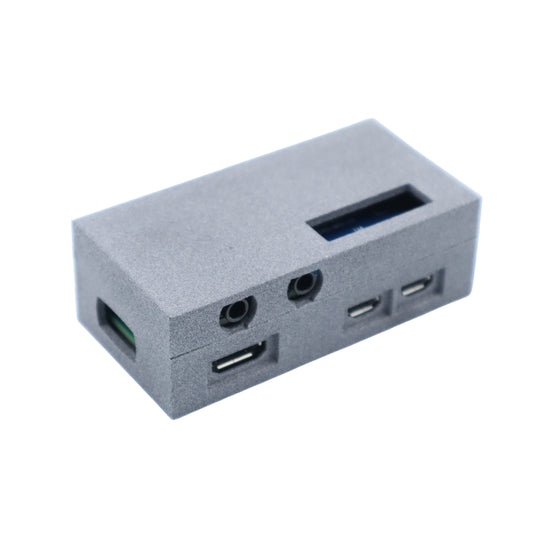


If you’re building a compact, travel-friendly Eurorack setup, think small cases, minimal modules, maybe a “lunchbox” rig to jam on the go, then power supply is often the trickiest part. Finding the right Eurorack power supply for a small case usually means choosing between bulky traditional bricks and something that actually fits.
That’s where a USB-C powered supply becomes a game-changer. Enter the Compact Eurorack Power Supply USB-C Powered: a miniature, no-fuss PSU designed specifically for tiny Eurorack rigs.
With a USB-C plug you already use for phones or laptops, you can skip the bulky adapter and still get clean ±12 V (and even +5 V) rails for your modules. Perfect if you want portability without sacrificing reliability.
Tech specs at a glance
Here’s what this compact Eurorack power supply brings to the table:
- Output: ±12 V up to 125 mA maximum. Good for small setups.
- Secondary rail: +5 V at ~1 A or more (depending on your USB power adapter).
- Input: USB-C (5 V) meaning you can plug it into a laptop charger, modern phone charger, or even a power bank.
- Size: 56 mm × 42 mm × 14 mm for the 2 connectors version and 71 mm x 42 mm x 14 mm for the 3 connectors version.
- 2 or 3 Bus connectors: 2 × standard 16-pin Eurorack bus headers, plus one 10-pin connector on the newer version.
- Overload protection: The supply auto-recovers after fault conditions; as a caveat, avoid connecting capacitors over 1000 µF on the 12 V rails to prevent instability.
- Form factor: Especially suited for small cases (roughly 20 HP to 40 HP) or travel-friendly rigs.
And yes, despite its size, it’s a “real” Eurorack PSU: dual rails, standard bus headers, and just enough juice to power a few Eurorack modules without overkill.
How to chain two modules (or expand your rack)
One of the nicest features of this Eurorack power supply is its “chainable” design. Here’s how you can leverage that:
- Connect CHAIN+ from the main module to CHAIN+ on the 2nd module
- Connect CHAIN_GND from the main module to CHAIN_GND on the 2nd module
- The connection can be made with pins headers if provided, or by soldering a small wire between both modules.
- Only one module should be connected to USB-C!
- If possible the 2nd module should not have the USB module soldered on
This gives you either more module slots or extra power headroom, depending on your needs.
In other words: start small, but with the option to grow without redesigning your rack. Perfect for modular beginners or traveling synth heads.

Who is this supply for
This Compact USB-C PSU is ideal if you:
- Build small, travel-friendly or minimalist Eurorack cases (lunchbox rigs, skiffs, etc.).
- Want to power 2–4 small modules (especially low-power ones).
- Don’t want bulky external bricks or complex PSU wiring.
- Value portability: could even power from a power bank or laptop charger.
However: because the max ±12 V output is only 125 mA. Heavy, digital modules or larger setups with many modules will demand more current. In that case, a more powerful dedicated PSU would be a safer bet.
Final thoughts
If you’re dreaming of a scratch-built little personal synth lab, lightweight, portable, and easy to power, this Compact USB-C Eurorack Power Supply is a clever, budget-friendly entry. It’s like the “starter battery” for your modular journey: small, simple, but fully functional, and thankfully, expandable.
It won’t power a huge rack, but for a compact rig it’s a solid, elegant solution.
FAQ
Can I power a Eurorack case from a power bank?
Yes. Aas long as the power bank supports USB-C output at 5V with enough current (most modern ones do), it can power this compact Eurorack power supply the same way a phone or laptop charger would.
How many modules can 125 mA on the ±12V rails actually run?
It depends on the modules, but 125 mA is generally enough for 2–4 small analog modules (VCOs, simple filters, basic utilities). Power-hungry digital modules will eat into that budget fast, so it's worth checking each module's current draw before building out a rack.
What's the difference between the two connector versions?
The newer version adds a 10-pin connector alongside the standard 16-pin headers, giving you an extra option for modules that only need the ±12V rails without +5V.
Do I need a separate power brick if I already have a USB-C charger?
No. That's the main advantage of this supply. Any USB-C charger rated for 5V (modern phone charger, or power bank) can power it directly.
